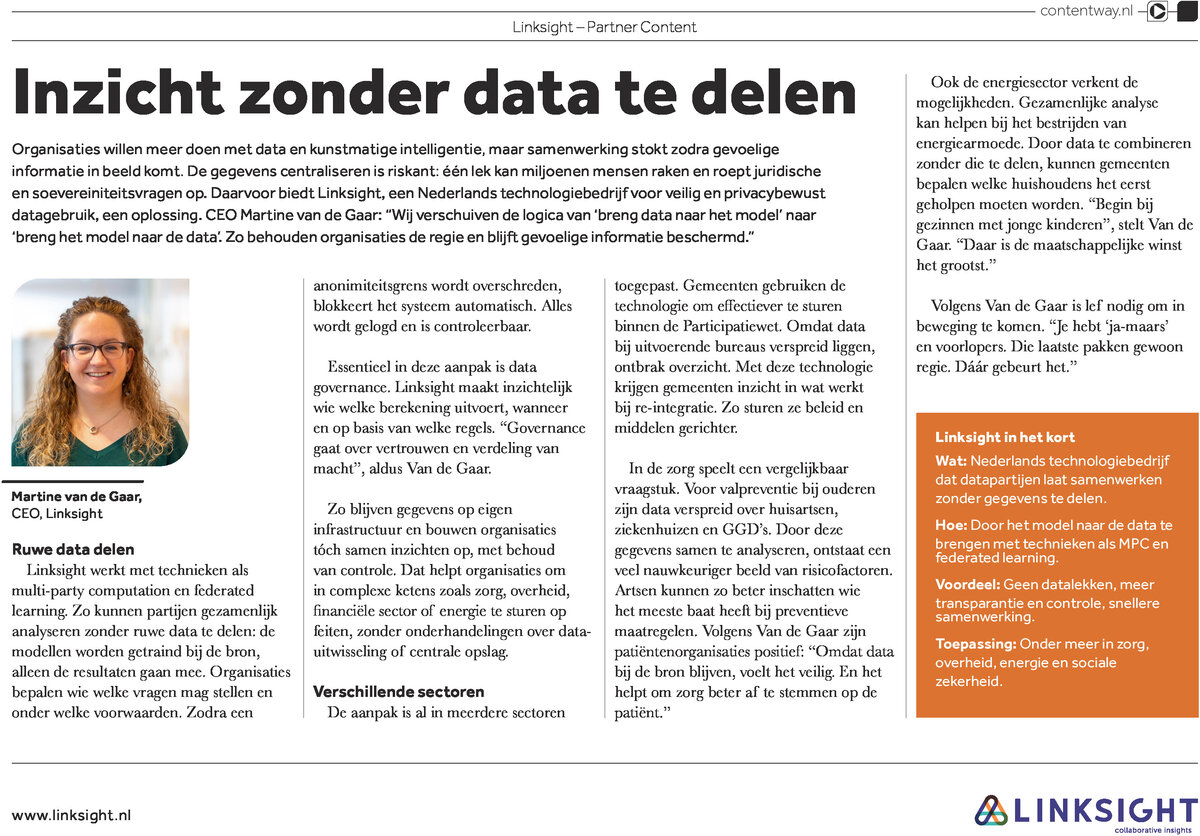
From risk to control
September 2025This article was originally published in Dutch in a special supplement of Het Financieele Dagblad on AI & Data Sovereignty. For your convenience, we have translated it here.
Insight without sharing data
Organisations want to do more with data and artificial intelligence, but collaboration stalls as soon as sensitive information enters the picture. Centralising data is risky: a single breach can affect millions of people and raises legal and sovereignty concerns. Linksight, a Dutch technology company for secure and privacy-conscious data use, offers a solution. CEO Martine van de Gaar: “We are shifting the logic from ‘bring the data to the model’ to ‘bring the model to the data’. This way, organisations stay in control and sensitive information remains protected.”
Sharing raw data — without actually sharing it
Linksight works with techniques such as multi-party computation and federated learning. This allows parties to jointly analyse data without sharing raw data: models are trained at the source, and only the results are shared. Organisations decide which questions may be asked and under which conditions. As soon as an anonymity threshold is exceeded, the system automatically blocks the request. Everything is logged and auditable.
Governance as the foundation
Central to this approach is data governance. Linksight makes it transparent who performs which computation, when, and based on which rules. “Governance is about trust and the distribution of power,” says Van de Gaar. Organisations retain their own infrastructure and still build shared insights — with full control. This helps organisations in complex sectors such as healthcare, government, finance and energy to make decisions based on facts, without negotiations about data exchange or central storage.
Applied across sectors
The approach is already being applied in multiple sectors. Municipalities use the technology to steer more effectively within the Dutch Participation Act. Because data is spread across various executive agencies, there was previously no clear overview. With this technology, municipalities gain insight into what works in reintegration, allowing them to direct policy and resources more effectively.
In healthcare, a similar challenge exists. For fall prevention among the elderly, data is spread across general practitioners, hospitals and public health services. By analysing this data together, a much more accurate picture of risk factors emerges. Doctors can better assess who benefits most from preventive measures. According to Van de Gaar, patient organisations are positive: “Because data stays at the source, it feels safe. And it helps to better tailor care to the patient.”
The energy sector is also exploring the possibilities. Joint analysis can help combat energy poverty. By combining data without sharing it, municipalities can determine which households need help first. “Start with families with young children,” says Van de Gaar. “That is where the social benefit is greatest.”
Pioneers take charge
According to Van de Gaar, it takes courage to get things moving. “You have the ‘yes-buts’ and the pioneers. The latter simply take charge. That’s where it happens.”
Read the full article in the AI & Data Soevereiniteit supplement of Het Financieele Dagblad, or download the PDF.