Healthcare
From waiting lists to regional collaboration. Insight across the whole chain, while the data stays with each organization.
Care for a single patient passes through many organizations: hospitals, general practitioners, elderly care, mental health care, municipalities and health insurers. Each sees part of the journey, and patient data may not leave its own organization. Linksight lets healthcare parties jointly analyze what happens across their boundaries, from waiting lists to regional collaboration.
Care pathway analysis
Follow complete patient journeys across organizations, and see where care stalls.
Care pathway analysis follows the sequence of care a patient receives across providers and over time, to find delays, variations, and bottlenecks. Those journeys cross organizational borders, and the records that describe them cannot simply be brought together. Providers, pharma, payers, and government see where patients wait, how treatment sequences differ, and which routes lead to better outcomes. Care improves at the level where it matters: the whole journey, not the isolated visit. Linksight links the fragmented data while it stays at each organization, protected by privacy-preserving encryption. Its governance framework lets the organizations analyze pathways together without exposing identifiable data.
Effectiveness studies
Measure whether an intervention truly works, across the whole care chain.
Effectiveness studies measure whether a treatment, intervention, or innovation delivers its intended results in daily care, from an eHealth app to expensive medicines. The effect rarely stops at the walls of one organization, yet the data that would show it sits with care providers, health insurers, and the social domain, and cannot be pooled. Providers, insurers, and policymakers learn which intervention works for which group of patients, and whether an innovation saves money or merely shifts costs elsewhere in the chain: the waterbed effect. In regional data collaborations, these studies feed a learning care system. Linksight measures across the whole chain, from general practitioner to hospital to insurer, while every organization keeps its data at home. Federated analytics deliver the answer, not the underlying records.
Real-world evidence (RWE)
Real-world evidence from data that never leaves the healthcare organizations.
Real-world evidence shows how treatments and care perform in everyday practice, as evidence for clinical research, regulatory decisions, and reimbursement. Getting it means linking routine care data held by many organizations, a process normally slowed by legal agreements, governance demands, and outdated extracts. Studies that run across multiple healthcare organizations at once become larger and more representative, in line with the European Health Data Space. Researchers, pharma, regulators, and payers get stronger evidence sooner and at lower cost. Linksight runs the analyses where the data lives, so nothing is centralized. Recurring studies reuse the same governed connections instead of restarting the paperwork.
Cleaner waiting lists, shorter waiting times
Remove duplicate waiting list entries and see the real demand for care.
Patients waiting for care often appear on several waiting lists at once, across hospitals, specialties, and separate IT systems. Every duplicate entry inflates apparent demand and distorts projected waiting times. With deduplicated lists, care providers stop booking duplicate appointments and plan capacity on real numbers. Patients get to care sooner, and prioritization between them becomes fairer. Linksight matches patient records across those systems, while the records stay with each organization. Duplicates surface; the underlying data does not.
Training AI without sharing data
Train AI on the health data of multiple organizations, without the data changing hands.
AI models for healthcare get better when they learn from more than one organization’s data. That data is exactly what hospitals cannot hand over: it is fragmented, uneven in quality, and bound by strict privacy and governance rules. With federatively trained AI models, clinicians get predictions and decision support tuned to their own patient population instead of someone else’s average. Advice that can be traced to well-governed training data is also easier to trust. With Linksight, organizations train models through federated learning: the model travels, the data does not. Governance and privacy controls stay in force at every participating organization.
Trial matching
Find eligible patients for clinical trials without opening a single record.
Clinical trial matching finds patients who meet a study’s eligibility criteria. Those criteria combine diagnoses, treatments, lab results, and history that are scattered across healthcare systems. The result of good matching: trials fill sooner, studies finish earlier, and more patients get access to treatments still in research. Care teams spend their screening time on likely candidates instead of whole files. Through Linksight, researchers search across care providers and see only aggregate counts; the data stays under each provider’s control. Identifying and contacting a candidate remains the work of that patient’s own care team.
Outcome based contract management
Measure real treatment outcomes, and let payment follow what works.
Outcome-based medicine measures the real-world results of treatments to learn what serves patients best. Outcome data sits with providers and insurers, collected inconsistently and disconnected from the care journey it belongs to. Clinicians see which treatments work best, and organizations benchmark and improve their quality of care. Reliable outcomes also make outcome-based payment contracts workable: a pharmaceutical company only gets paid if the treatment demonstrably works for the agreed patient group, which brings expensive therapies within reach. Linksight connects treatments, diagnoses, and follow-up events across systems without centralizing the data. The insights stay at the aggregate level, and no one gains access to an individual patient’s records.
Regional data collaborations
One shared picture of a region’s care, built without a regional database.
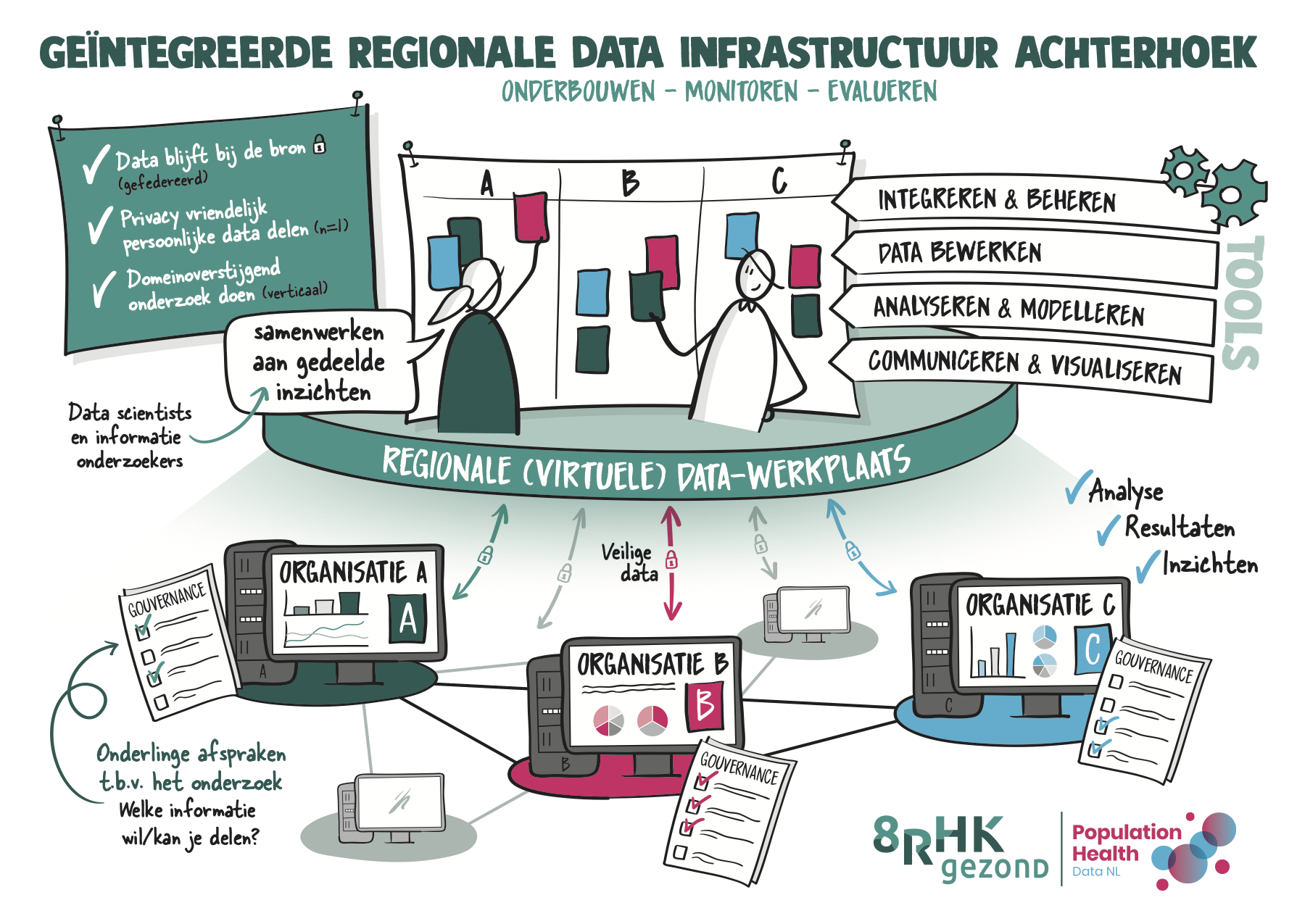
Regional data collaborations bring hospitals, general practitioners, elderly care, municipalities, and health insurers together around shared questions: how is acute care demand developing, where does capacity fall short, how can health be improved? The answers live in the combination of everyone’s data, and a central regional database has neither a legal basis nor the region’s trust. Organizations decide together where pressure is building, where scarce capacity should go, and which prevention pays off. Over time the region becomes a learning care system that measures and improves its own care. Linksight is the infrastructure underneath: every organization connects its own data station and keeps full control, while analyses produce region-level insights only. New questions reuse the same connections, without a new round of data-sharing negotiations.
Linksight in practice

Want to know how Linksight can support your case?
Every sector has its own questions. We are happy to think along about yours and show you how the Linksight platform works.
Other sectors
Screen, monitor and assess customers across institutions, without exchanging customer data.
One picture across agencies, without a central database of citizens.
Exchange an answer, not the file.
Measure which campaigns work across platforms, within the bounds of the GDPR.