Mental Health Organizations in Drenthe Use Privacy-Friendly Data Analysis to Address Waiting Lists
October 2025This article was originally published in Dutch on Datawerkplaats.net. For your convenience, we have translated it here.
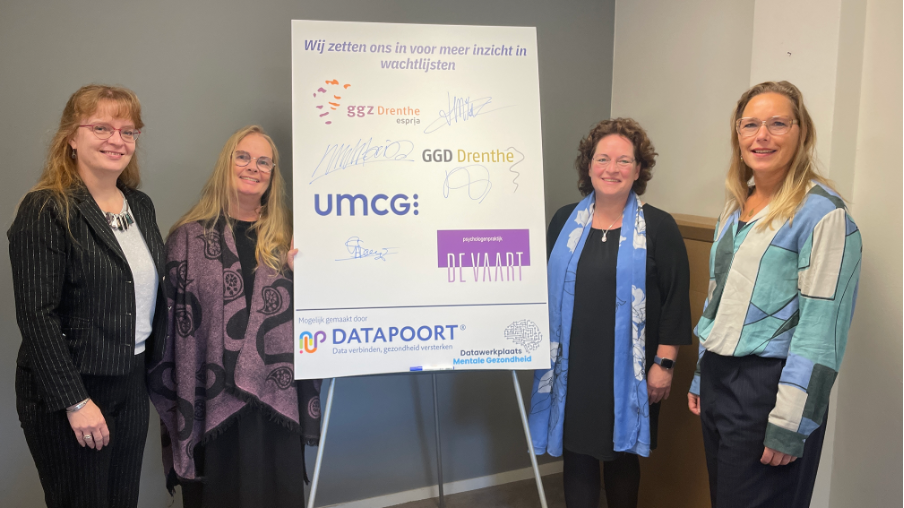
On October 16, 2025, an important step was taken in Drenthe to address waiting times in mental health care. GGZ Drenthe, GGD Drenthe, UMCG, and Psychologenpraktijk De Vaart signed an agreement to jointly work with Multi-Party Computation (MPC), a privacy-friendly analysis technique that enables secure combination of data from different parties.
The signing marks the start of a regional approach to gain better insight into waiting lists within mental health treatment. The participating parties are working together with Datapoort and Datawerkplaats Drenthe on solutions for the long waiting times in mental health care. Better visibility of who is waiting for care supports healthcare providers in making choices for the right care in the right place. With this collaboration, Drenthe is taking an important step towards future-proof, data-driven care, with respect for the privacy of its residents.
MPC: Privacy as a Starting Point
By using MPC, organizations can jointly perform analyses without sharing personal data. Source data is provided encrypted and is not visible to other parties. Analyses are made at group level. Everyone contributes a puzzle piece, so to speak, to create a complete picture, but no one can see the pieces of others.
By combining, for example, care requests and referral information with neighborhood information, information about living environment and socio-economic status, analyses can be made and duplicates on waiting lists can be identified without infringing on patient privacy. With better insight into those waiting, healthcare providers can better engage in conversations with patients about what care or support is needed or desired and can make more targeted referrals.
A Learning Network for Broad Applications
The collaboration between Datawerkplaats Drenthe and Datapoort forms the basis for this approach; they provide the technology. The participating parties provide human resources to create analyses. The organizations believe in the power of a learning network, in which they work together and use each other’s knowledge and infrastructure. Together they decide which analyses are made, starting with patients on the waiting list for mental health treatment in Drenthe. The technology also offers prospects for broader applications, such as analyses around vital aging or national accountability. The ultimate goal is to increase the effectiveness and efficiency of the Mental Health Network Drenthe.
Want to know more? Read the whitepaper MPC – New Insights Through Secure Data Combination (in Dutch)
Source: Datawerkplaats.net